Friday, July 23, 2010

Life of Butterfly


The life of a butterfly starts when male and female adult butterflies meet and mate while flying around each other in a meadow for a short span of time. The male adult butterfly then flies away from the female butterfly and the female butterfly finds place to lay her eggs. The female butterfly curves her long body in the direction of a leaf and lays her very tiny eggs on the surface of the leaf during the time of monsoon.
The eggs are made of sticky substance so that they wont fall from the leaf. The young stage known as larva is then developed inside the egg and one caterpillar will hatch out from one egg. The caterpillar grow very quickly, the more it eats the bigger it become in size. Eventually the caterpillar will shed from its first skin and grow a bigger skin. There is no time for caterpillar to sleep because it has to store as much energy as needed to change into butterfly. It is now time for the caterpillar to make chrysalis for butterfly and cocoon for moths. The caterpillar mus find a hard sturdy branch where it can spin silk threads around the branches. It will shed its skin for the last time and a shell will form underneath. This shell will hardens into a protective cover which is called Chrysalis.
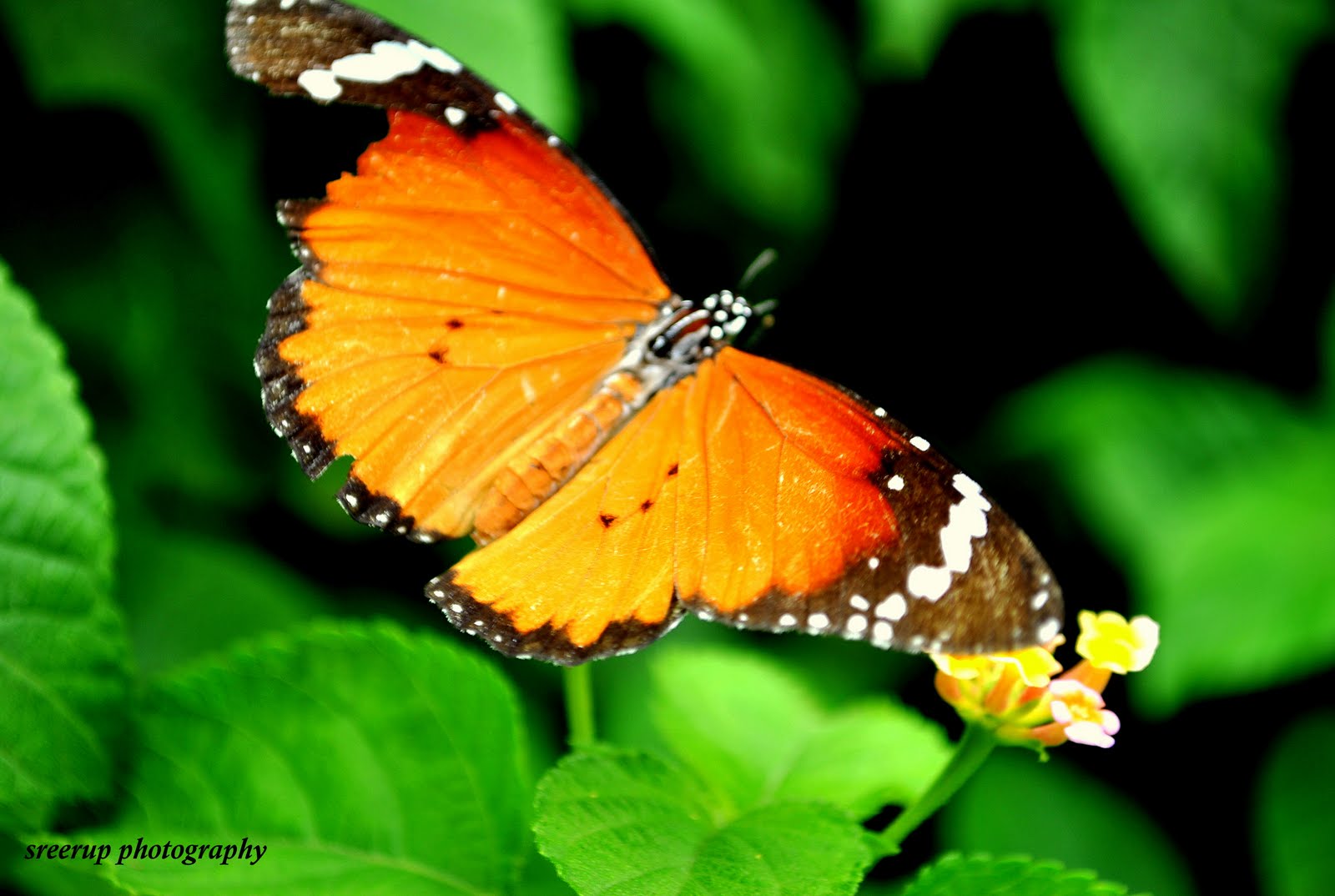
The caterpillar turns into a soft,squidy jelly like blob. The caterpillar then change into a beautiful butterfly after few weeks. When the chrysalis turns clear it is the appropriate time for butterfly to take its first flight. Once the butterfly breaks out its wings are wet and crumpled. The butterfly then pumps blood into its wings which will help to dry out and to expand.
This stage doesnot take long time.Once its wings are dry the butterfly is ready to fly away for the search of flowers. Not all butterflies hatch out of thier chrysalis, some spend winter month inside and hatch out in spring time. Most of the butteflies have short span of life about a month so it must find a mate quickly to start new life cycle all over again.
There are several butteflies that have longer lives (upto nine months). For these butterflies, when winter arrives, they will hibernate by findings a safe shelter. Butteflies use the sun to elevate their body temperature.

Tuesday, July 13, 2010

Yab-Yum

Yab-yum (Tibetan meaning "father-mother") is a common symbol in the Buddhist art of India, Bhutan, Nepal and Tibet representing the male deity in sexual union with his female consort. Often the male deity is sitting in lotus position while his consort is sitting in his lap.

The symbolism is associated with Anuttarayoga tantra and, while there are various interpretations of the symbolism in the twilight language, the male figure is usually linked to compassion (karuṇā) and skillful means (upāya-kauśalya), while the female partner to 'insight' (prajñā).

The symbolism of union and sexual polarity is a central teaching Tantric Buddhism, especially in Tibet. The union is realised by the practitioner as a mystical experience within one's own body.

Yab-yum is generally understood to represent the primordial (or mystical) union of wisdom and compassion. In Buddhism the masculine form is active, representing the compassion and skillful means (upaya) that have to be developed in order to reach enlightenment. The feminine form is passive and represents wisdom (prajna), which is also necessary to enlightenment. United, the figures symbolize the union necessary to overcome the veils of Maya, the false duality of object and subject.

Yab-yum may also be represented through the aniconic signification of yantra and mandala. In Tibetan Buddhism, the same ideas are to be found concerning the bell and the dorje, which, like the yab-yum, symbolize the dualism that must be exceeded. The sacred Tantric practice leads to rapid development of mind by using the experience of bliss, non-duality, andecstasy while in communion with one's consort.

In Hinduism the yab-yum has a slightly different meaning. There, the embraced posture represents the divine strength of creation. The Hindu concept is the one of a passive masculine deity embracing his spouse called shakti, which represents his activity or power. These figures are frequently worked in the shape of statues or reliefs, or are painted on thangkas.


Photographs by Sreerup Chakroborty

Reference: Samir Pathak and Sharmishtha Pathak


Chittaranjan Park fish market

Chittaranjan Park is a neighbourhood in South New Delhi, set up in the late 1960s to house Bengali migrants from what was then East Pakistan and soon after became Bangladesh. The evening time is best to take a "walk" through the market.
It comes alive with Bengalis eating their fill of the Calcutta style street food of mutton, fish chops, kathi rolls, and Calcutta Chinese street food. Yum! It's also the best place to go a hunting for freshwater fish, an integral part of Bengali cuisine.


If you can stomach the stink of fresh and dried seafood and fresh water fish this place is unbelievable.It is popularly known that wherever there are fishes there are bengalis. Chittaranjan Park is the main place to buy fishes from rohu to hilsa.

Thursday, June 24, 2010

My Pet

My pet is a fish. It is a "OSCAR".
Astronotus ocellatus is a species of fish from the cichlid family known under a variety of common names including oscar, tiger oscar, velvet cichlid, or marble cichlid. In South America, where the species naturally resides, A. ocellatus are often found for sale as a food fish in the local markets. The fish can also be found in other areas including China, Australia, and the United States. Although its slow growth limits its potential for aquaculture, it is considered a popularaquarium fish.A. ocellatus have been reported to grow into a length of 34 cm (approximately 15 in) and a mass of 1.6 kg (2.6 lb). The wild caught forms of the species are typically darkly coloured with orange ringed-spots or ocelli on the caudal peduncle and on the dorsal fin. It has been suggested that these ocelli function to limit fin-nipping by piranha (Serrasalmus spp.) which co-occur with A. ocellatus in its natural environment. The species is also able to rapidly alter its colouration, a trait which facilitates ritualised territorial and combat behaviours amongst conspecifics. Juvenile A. ocellatus have a different colouration from adults and are striped with white and orange wavy bands and have spotted heads.

This fish is very intelligent, it can even recognize it’s owner. Oscars have they own ideas, although they're not the only fish having them. If Oscars don´t like how the items are placed in the aquarium, they pick them up and replace them, or they spit it out from the tank. It doesn’t matter if the plant orrock is real or plastic. If you have a high aquarium, standing near it can be dangerous. The best choice is to have a sand bottom and a few big rocks in the tank. Sometimes Oscars pretend that they are dead. In nature they pretend to be dead and wait until a small fish comes close so it can be caught and eaten.


Basic information about the Oscar fish species:

Maximum size (min-max): 30.0 - 40.0 cm ( 11.8 - 15.7 in)
Recommended temperature: 24.0°C - 30.0°C ( 75.2°F - 86.0°F)
Recommended water hardness (dGH): dGH 4.0 - 18.0 N
Recommended pH of water: 6.5 - 7.5
Origin: South America


Random Collections


Rain in Gurgaon

Its being late hot afternoon of Gurgaon and i just woke up from sleep. I went to drawing room and found small sized hailstones spread all over the floor and happy to see its raining outside. Small children douse in rain water, playing and shouting out of joy. All the living individuals were blissful to feel spirit of rain. Peacock started dancing and shouting. I like he smell of dust in air when rain water infuse the hot dehydrated ground. I tried to capture some pictures at the onset of rain.


My Sketches


These are some of my sketches and i am really thankful to rimi for encouraging me to start all over again.

Wednesday, June 23, 2010

Manali

It was 12th August 2009 and i had just reach home from my work place. I asked rimi for going on a holiday. We then decided to go for Manali and reached Manali on 15th early morning. I was sleeping in the bus but suddenly i woke up hearing the ripple of river beas. The picturesque beauty of standing tall pine woods and the play of clouds in light and shadow with blinking sun makes me feel that i am in some new world away from busy city life. My wife was completely tired because of the overnight bus journey.We took room in lord regency hotel and the room was facing the river beas at the backdrop of dense pine wood. We took rest that day and then in the evening we went to Manali's the famous "Mall Road"
The Mall Road
The main market area of m Manali is known as Mall Road. Its is a straight road and shops are located on either sides. It is the main shopping attraction for tourists. The place gets crowded in the evening and one can buy shawls, Kullu caps, and other himachalli handloom staffs. Many hotels are on this road and thats why it is the busiest part of the town.
Day two (16th August 2009)
We started our day by hiring a taxi from mall road and went for day long local sight seen. We first stopped at Tibetan Monastery which is situated at the middle of the town. We then continued our journey up to Hidimba Temple.


About Manali
Manali is named after the Brahmin law-giver Manu. The word Manali literally means "the abode of Manu". Legend has it that sage Manu stepped off his ark in Manali to recreate human life after a great flood had deluged the world. The Kullu district of Himachal Pradesh in which Manali can be found is also known as the "Valley of the Gods". The Old Manali village has an ancient temple dedicated to sage Manu.

It is also believed that the Hidimba Devi lived in the jungles of Manali. The story of Hidimba Devi is recorded in Mahabharata, a famous holy book of the Hindus. The Hidimba Devi Temple in Manali is the most famous temple dedicated to Hidimba.The British introduced apple trees and trout, which were not native to Manali flora and fauna. It is said that when apple trees were first planted the fruits were so plentiful that often branches, unable to bear the weight, would collapse. To this day, apple - along with plum and pear - remains the best source of income for the majority of its inhabitants.
In the last 20 to 30 years Manali became famous and the town began to spread and grow in size. Initially there were only few shops and not a single hotel in Manali. Today, this once quiet village has transformed into a bustling town with many hotels and restaurants.
We came in the late evening to the hotel. Had spend the entire evening sitting at balcony with a glass of whiskey ,hearing the wavy sound of river beas and gleaming reflection of moonlight on the flowing water.

Day three (17th August-2009): Rohtang Pass
We started our journey at 10:00 hrs and reached rohtang pass at 14:30 hrs.
About Rohtang Pass
Rohtang Pass (Tibetan: Rohtang La) (altitude 13,051 ft (3,978 m)), is a high mountain pass on the eastern Pir Panjal Range of the Himalayas some 51 km (32 mi) from Manali. It connects the Kullu Valley with the Lahaul and Spiti Valleys of Himachal Pradesh, India.

The pass provides a natural divide between the sub-humid/humid Kullu Valley with a primarily Hindu culture (in the south), and the arid/semi-arid high-altitude Lahaul and Spitivalleys with a Buddhist culture (in the north). The pass lies on the watershed between theChenab and Beas Basins. On the southern side of this pass, the Beas River emerges from underground and flows southward and on its northern side, the Chandra River, a source stream of the river Chenab, flows westward. The pass is open from May to November. It was not particularly high or difficult to cross on foot by Himalayan standards, but it had a well-deserved reputation for being dangerous because of unpredictable snowstorms and blizzards.